About
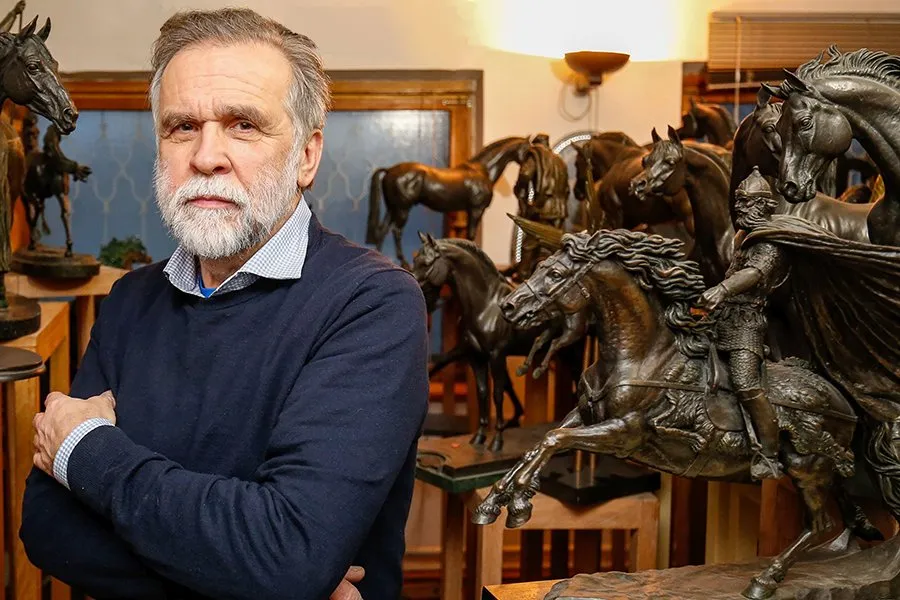
Sergey Bondarenko was born in Minsk in 1956. He has spent more than four decades working in bronze, and for most of that time the horse has been his central subject.
The interest began early. Summers in the countryside were spent near the stables, modelling his first figures in plasticine. What began as a boy's fascination became a lifelong specialism — the hippological genre, a demanding and rarely practised branch of animal sculpture, in which anatomical accuracy is not a technique but the entire premise.
He trained at the Republican Boarding School of Music and Fine Arts, graduating in 1974, and then at the sculpture department of the Belarusian Theatre and Art Institute, completing his studies in 1981 under L. Davidenko, A. Bembel, A. Anikeichik and G. Muromtsev. From 1982 to 1985 he worked in the creative studios of the USSR Academy of Arts under Zair Azgur. He has exhibited since 1979, and has been a member of the Belarusian Union of Artists since 1985. Since 2003 he has been an honorary member of the Chinese Academy of Arts, and his work is included in its catalogue of five hundred leading artists.
Bondarenko works in the lost-wax method, and carries out every stage of the process himself — from the plasticine study, through the wax model and the mould, to the pouring of the bronze. It is an unusual way to work. Most sculptors hand the casting to a foundry. He does not. The result is a bronze that is authorial from beginning to end, and it accounts for the finish his work is known for.
The horses are modelled from life. He has spent years among sport horses and their riders, at shows and championships across Europe and the United States, and he knows the animals as an equestrian knows them — by conformation, by temperament, by breed. In 1995, at an Arabian championship in Minnesota, he was invited to choose a horse to model. He picked a young stallion, Legacy of Gold, that went on to become a champion in the United States. Critics have remarked on the closeness of the likeness in his work; the sculptures are recognisably particular animals rather than generic ones.
Alongside the studio work he has completed some of the most visible public sculpture in Belarus: the relief panel "Piesnia pra zubra" (Song of the Bison) in the foyer of the National Library of Belarus (2006); the Triumph stele and the Alley of Olympic Glory at the Minsk-Arena complex (2009); the equestrian monument to Grand Duke Algirdas in Vitebsk (2014); Hospitable Belarus at the Palace of Independence (2015); and the sculptural groups at the Belarusian State Circus.
He also works in wood and ceramic.
His sculpture has been exhibited in Belgium, China, France, Germany, Monaco, the Netherlands, Poland, Russia, the United Kingdom and the United States. It is held in the collections of the National Art Museum of the Republic of Belarus and the Mogilev Art Museum, in galleries in Moscow, St Petersburg, Halle, Hamburg, Dortmund and Minneapolis, and in private collections across Europe, Asia and the Americas.
He lives and works near Minsk.